

What Is Agentic Browsing?
Websites have traditionally been designed primarily for people using browsers and search engines finding content.
AI agents present a different interaction model. In addition to simply reading a page, an agent may need to understand the interface, identify available actions, and act on behalf of a user interacting with a website.
Lighthouse 13.3 has introduced Agentic Browsing as part of its default configuration, bringing checks about AI-agent interaction into Lighthouse along with its existing auditing capabilities.
The question is shifting from:
“Can users and search engines understand this website?”
to:
“Can an AI agent understand what this website has to offer and interact with it reliably?”
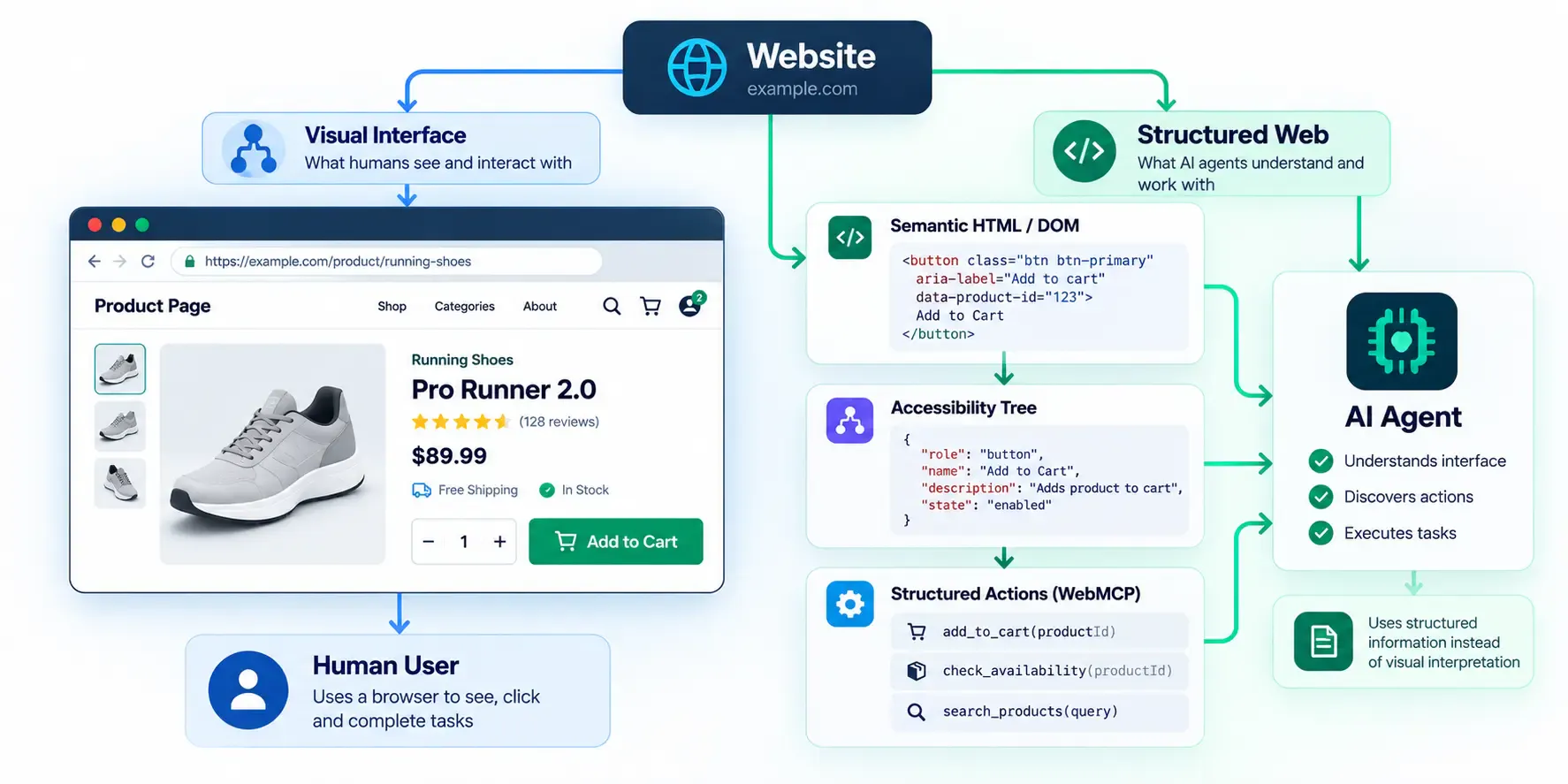
What Does Lighthouse Check for AI Agents?
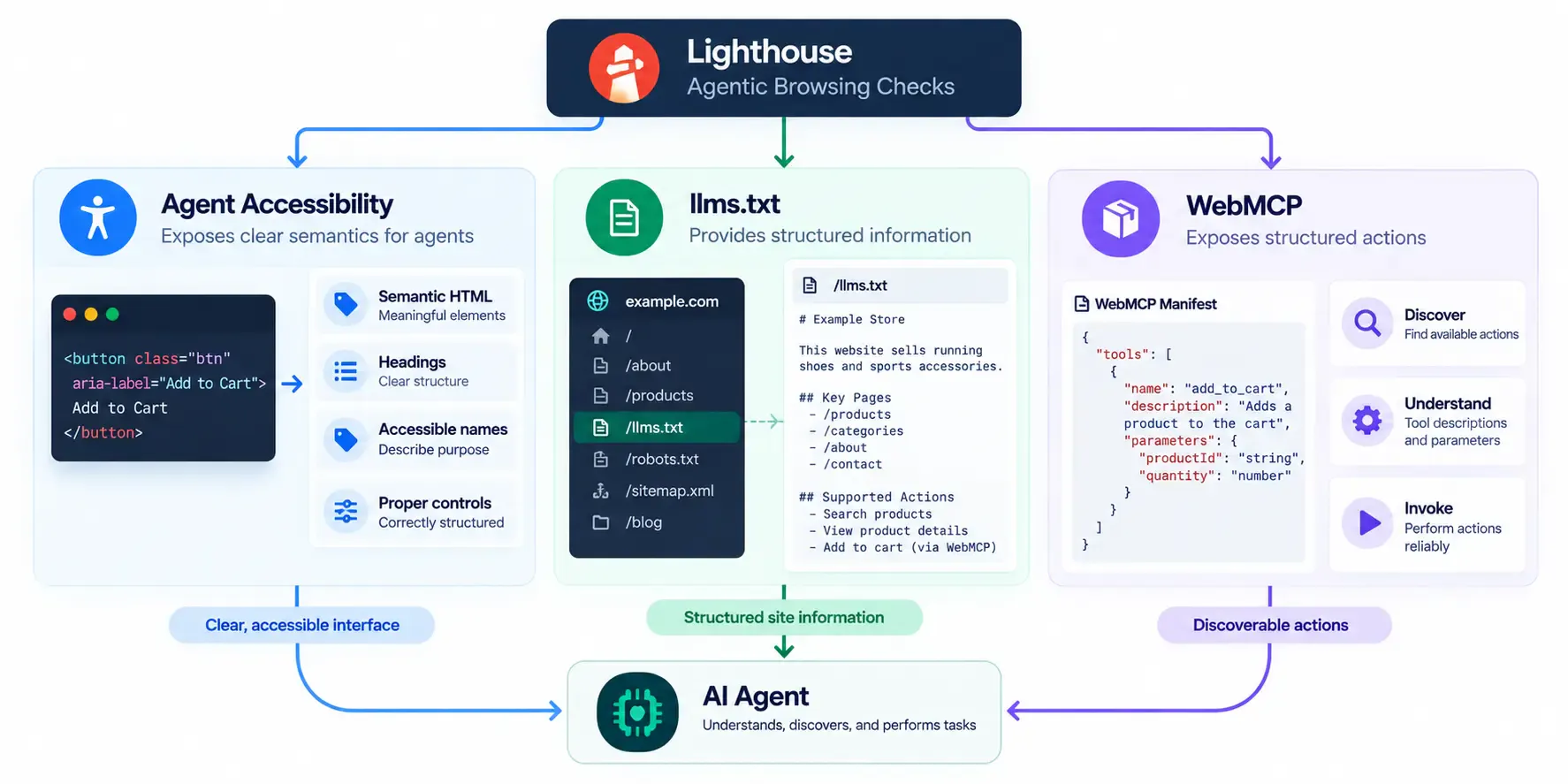
Agentic Browsing is not one test; it's a collection of checks that attempt to evaluate an agent's ability to understand a web page and find interactions it supports.
Agent Accessibility
Semantic HTML, accessible names, labels, headings, and correctly structured controls expose the semantics of an interface.
A button labelled "Add to Cart", for example, provides more information about its purpose than an unlabelled visual icon might.
llms.txt
llms.txt is an emerging convention for exposing a summary of useful information on a website to AI systems.
It may live at:
/llms.txt
It should not be confused with robots.txt or sitemap.xml, and serves a different purpose altogether
WebMCP
WebMCP experiments with new ways that websites can expose structured actions for AI agents to discover and invoke, rather than interacting visually or through the DOM.
How WebMCP Change the Ways Websites are Interacted
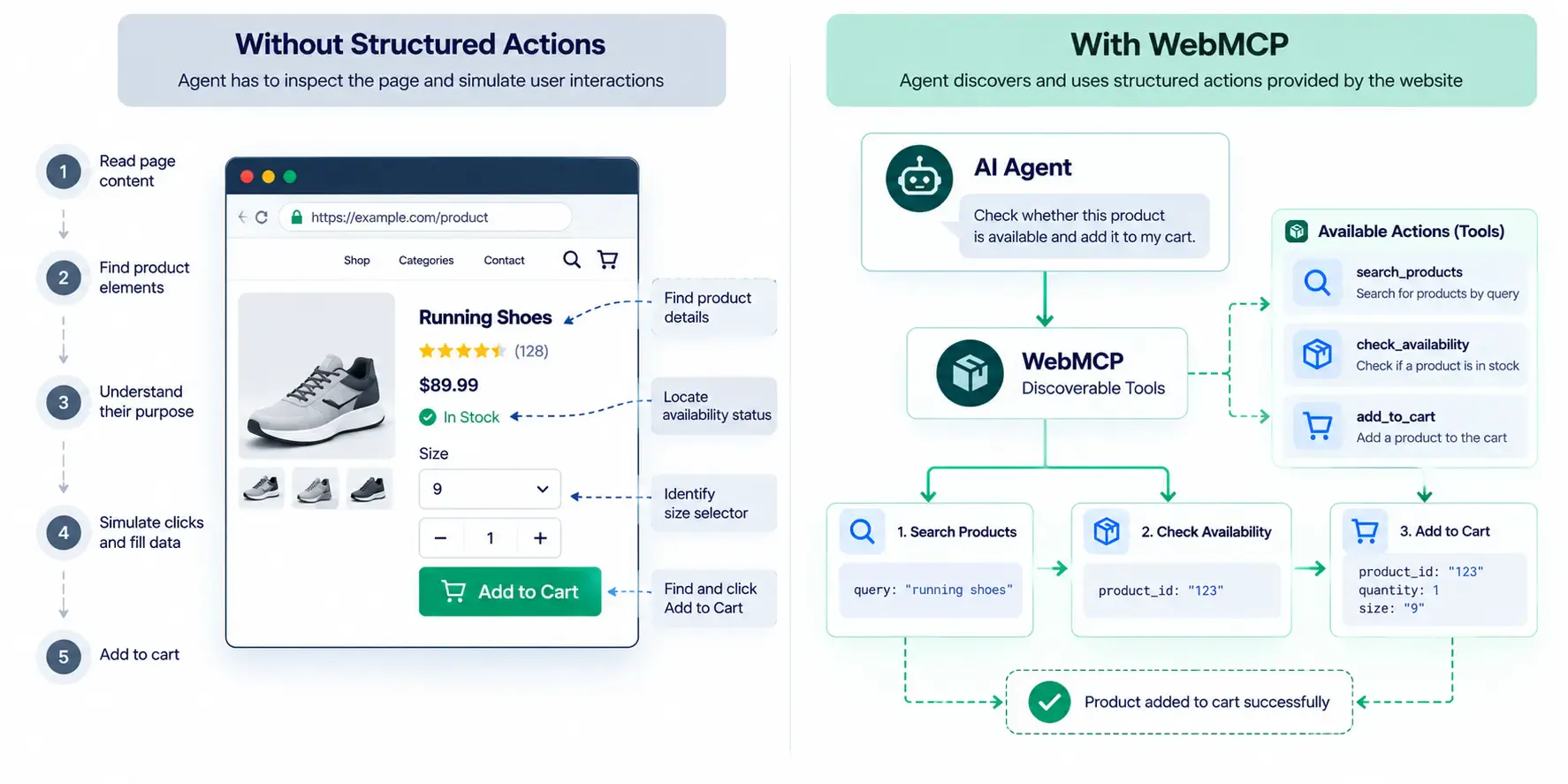
A lot of the time, reading the text on a website is only half the story when it comes to agentic browsing. In addition to reading information from websites, AI agents may need to perform certain tasks on websites as well.
Think about asking an AI assistant to read something on a website, like
Check whether this product is available and add it to my cart.
An agent would then potentially have to inspect the page, find the right buttons, figure out what they do, and simulate the necessary clicks. WebMCP tries to make this process a bit easier by suggesting that websites expose tools as discoverable actions on the website. For example, an e-commerce website might expose actions like
Search Products → Check Availability → Add to Cart
instead of an agent trying to guess what each button and element on a website does. An agent could then figure out what actions are available and what information it needs to perform them.
WebMCP is not yet a fully realized technology, so it should not be expected to be a universal standard anytime soon.
Should Developers Change Their Websites Now?
There is no need for everyone to re-platform their website around AI agents because Lighthouse has announced Agentic Browsing.
The ecosystem is emerging, and for now, developers should focus on foundational web fundamentals such as:
- Semantic HTML
- Accessible controls with meaningful names
- Correct document structure
- Leaving important publicly accessible content crawlable
- Properly maintained robots.txt and sitemap.xml
- Investigating llms.txt when it provides useful context about the website
- Following WebMCP as browsers and specs evolve
Many of these same practices improve the experience for AI agents, humans, assistive technologies, and search engines.
The goal should not merely be another high Lighthouse score, but rather making website contents and functionality predictable and accessible.
Conclusion
The Web Is Becoming AI-Operable
Lighthouse Agentic Browsing provides an early look at how websites may evolve as AI agents become another way people interact with the web.
The fundamentals remain familiar: semantic HTML, accessibility, structured content, and clearly defined interactions.
What changes is who—or what—may be using that structure.
A website may no longer need to be understandable only to people and search engines. It may increasingly need to communicate its content and supported actions to AI agents as well.
Agentic Browsing, llms.txt, and WebMCP are still evolving, but they point toward an important direction:
The future web may need to be not only human-readable and machine-readable, but also machine-operable.
